Reverse Engineering and Deformulation: The Q1/Q2 Framework for Decoding Any Formulation

Percevia Team
What Is Reverse Engineering (Deformulation) of Formulations?
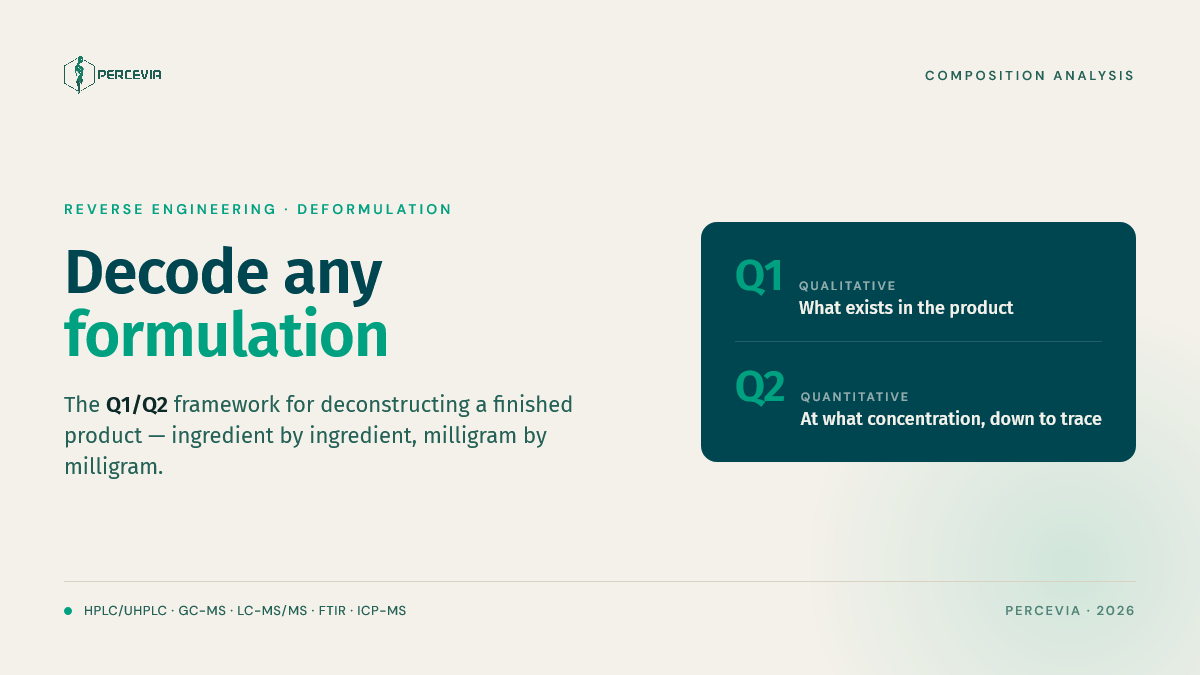
Reverse engineering, also called deformulation, is the laboratory process of deconstructing a finished product to answer two questions: what is in it, and in what quantity. Analytical chemists call this Q1 and Q2. Q1 (qualitative) establishes the identity of every component: actives, excipients, preservatives, functional additives, and any proprietary delivery vehicle. Q2 (quantitative) measures the exact concentration of each identified component, down to trace levels. Together, Q1 and Q2 produce a verified formulation profile built entirely from analytical evidence — not from a label, a patent claim, or a safety data sheet, which can be incomplete, outdated, or, in the case of trade-secret-protected formulations, deliberately vague.
This is the same discipline behind Percevia's Composition Analysis capability, which already includes a dedicated deformulation service for antimicrobial and sanitizing products (internal reference SAN-009: full reverse engineering of disinfectant formulations, revealing chemical composition, antimicrobial actives, and proprietary technologies). The same Q1/Q2 methodology extends directly to cosmetics, topical and oral pharmaceuticals, nutraceuticals, and agrochemicals.
Why Formulations Are Difficult to Deformulate
A finished product is rarely a simple mixture. Inactive excipients are often present at higher concentrations than the very actives they surround, masking the signal the analyst needs to isolate. Actives can sit at trace levels or below 1% within complex matrices — emulsions, suspensions, multilayer controlled-release coatings — where the physical structure affects how components are extracted and separated. Manufacturers also encode real technical differentiation into a formulation: a specific polymorph, a particle size distribution, the chemistry of a release vehicle, a preservative system tuned to a particular pH and packaging. None of that shows up on an ingredient list, and telling a deliberate formulation choice apart from batch-to-batch variation requires reference standards, validated methods, and an analyst who understands the chemistry — not just the instrument output.
The Q1/Q2 Analytical Workflow
Step 1 — Preliminary Physical Characterization
Before any sample reaches a chromatograph, it is physically characterized: appearance, odor, pH, viscosity, density, and, where relevant, particle size distribution. These properties already point to the formulation's likely category (emulsion, solution, or suspension) and guide which extraction and separation methods will actually work on that matrix.
Step 2 — Chromatographic Separation
HPLC/UHPLC separates and quantifies non-volatile actives, preservatives, and degradation-related impurities. Gas chromatography (GC, GC-MS) resolves volatile and semi-volatile components, including fragrances and residual solvents. Gel permeation chromatography (GPC) characterizes polymers and molecular weight distributions when the formulation includes film formers, thickeners, or controlled-release polymers.
Step 3 — Mass Spectrometry Identification
LC-MS/MS and GC-MS provide the structural confirmation that retention time alone can't offer: molecular mass, fragmentation pattern, and, with high-resolution mass spectrometry (HRMS), exact mass. This is the step that distinguishes a genuine active from a structurally similar impurity or metabolite, and it's essential for identifying undeclared or unexpected components.
Step 4 — Spectroscopic Confirmation
FTIR and Raman confirm functional groups and, for solid actives, crystalline form — relevant because the polymorph chosen directly affects solubility and bioavailability. ICP-MS/ICP-OES quantifies elemental content and heavy metals, important both for the safety profile and for identifying inorganic actives or fillers that chromatography alone wouldn't detect.
Step 5 — Quantification and Formulation Reconstruction
Each identified component is quantified against calibrated reference standards, and the results are reconciled into a mass balance: the sum of identified components should essentially account for the entire mass of the sample. Gaps in that balance flag components that need additional targeted methods before the Q1/Q2 profile is considered complete.
Applications of Reverse Engineering and Deformulation
Competitor Benchmarking and Claims Verification
Understanding exactly what a competitor's product contains — and at what concentration — is the factual basis for comparing performance, positioning a reformulation, or verifying whether a competitor's advertising claims match its actual formulation.
Generic and Similar Product Development
Developing pharmaceutical generics and cosmetic "similares" starts from a target formulation profile. Deformulation analysis provides the Q1/Q2 data needed to reconstruct that profile as a starting point for in-house R&D — which still requires independent formulation development, stability studies, and, for drugs, bioequivalence studies before commercialization.
Intellectual Property and Patent Investigation
Deformulation data can support an internal assessment of whether a marketed product is consistent with the composition claimed in a patent, or serve as one input into a freedom-to-operate analysis. This is analytical evidence, not a legal opinion — it's up to intellectual property counsel, not the lab, to determine the evidentiary weight of that evidence in a dispute.
Batch Variability and Root-Cause Investigation
When a product underperforms, degrades prematurely, or fails an internal specification, comparing a problem batch against a reference batch at the Q1/Q2 level often isolates the variable ingredient, contaminant, or concentration deviation responsible.
Contamination and Adulteration Detection
The same hyphenated techniques used in deformulation (LC-MS/MS, GC-MS) are used to identify undeclared or unexpected substances in a product — unreported preservatives, banned actives, or process contaminants — regardless of whether the goal is competitive analysis or safety investigation.
What Types of Products Can Be Deformulated?
- Cosmetic and personal care formulations (creams, serums, sunscreens, hair products)
- Topical and oral pharmaceutical forms
- Disinfectants and sanitizing products
- Nutraceuticals and dietary supplements
- Agrochemical formulations
Regulatory Context: Where Deformulation Fits
Deformulation is a research and competitive intelligence tool, not a substitute for a formal regulatory submission. Even so, the same analytical rigor applies: impurity and degradation product identification follows the reporting, identification, and qualification thresholds set by ICH Q3A (new active substances) and Q3B (new drug products); residual solvent quantification follows ICH Q3C; elemental impurity limits follow ICH Q3D. For clients operating under ANVISA, FDA, or EMA rules, a deformulation study is typically framed as supporting R&D evidence, which informs — rather than replaces — the formal stability, impurity, and equivalence studies those agencies require.
What to Expect: Scope, Samples, and Timeline
Timeline depends on the formulation's complexity and how many analytical techniques the matrix requires — a topical formulation with a single active resolves faster than a multi-active controlled-release product with a polymeric coating. Studies are scoped after an initial sample review, which also defines the minimum quantity needed to run the full Q1/Q2 workflow without exhausting the material on a single technique.
Frequently Asked Questions
What's the difference between Q1 and Q2 analysis?
- Q1 identifies which components are present in a formulation — actives, excipients, preservatives, and additives. Q2 quantifies the exact concentration of each identified component. A complete deformulation study delivers both: identity and quantity for every ingredient found.
How much sample material is needed for a deformulation study?
- It depends on the formulation and how many analytical techniques the matrix requires, since some methods are destructive and consume the material tested. The sample quantity is confirmed after an initial review of the product type and the techniques the study will require.
Can reverse engineering identify proprietary or patented technologies?
- It can identify the chemical components and concentrations present, which may correspond to a patented formulation or delivery technology. Confirming that a specific finding constitutes patented technology, and what that means in terms of freedom to operate, is a legal determination made by intellectual property counsel using the analytical data as one input.
Is deformulation analysis admissible as evidence in an IP or patent dispute?
- Analytical data can be used as supporting evidence in intellectual property matters, but its admissibility and evidentiary weight depend on jurisdiction, method validation, and chain-of-custody documentation — questions for legal counsel, not the lab. A validated, well-documented methodology strengthens the data's usefulness in this context.
Can reverse engineering be used to develop a generic version of a product?
- Deformulation provides the Q1/Q2 formulation profile that generic and similar product development typically starts from. On its own, it doesn't constitute a finished generic product — independent formulation development, stability studies, and, for drugs, bioequivalence studies are still required before commercialization.
What analytical techniques are used in deformulation studies?
- A typical workflow combines physical characterization (pH, viscosity, density, particle size), chromatography (HPLC/UHPLC, GC, GPC), mass spectrometry (LC-MS/MS, GC-MS, and HRMS for exact mass), and spectroscopy (FTIR, Raman, ICP-MS/ICP-OES for elemental content), selected according to the formulation type.
How long does a typical reverse engineering study take?
- Timeline depends on the number of components, the formulation's complexity (for example, a simple solution versus a multilayer controlled-release product), and how many techniques are needed to close a complete mass balance. Timelines are confirmed after an initial review of the sample and scope.
Does deformulation work on complex formulations, like emulsions or controlled-release products?
- Yes, though complex matrices generally require more extraction and separation steps to isolate each component clearly. Emulsions, suspensions, and multilayer controlled-release systems are analyzed with the same Q1/Q2 framework, adapted with additional matrix-specific sample preparation.
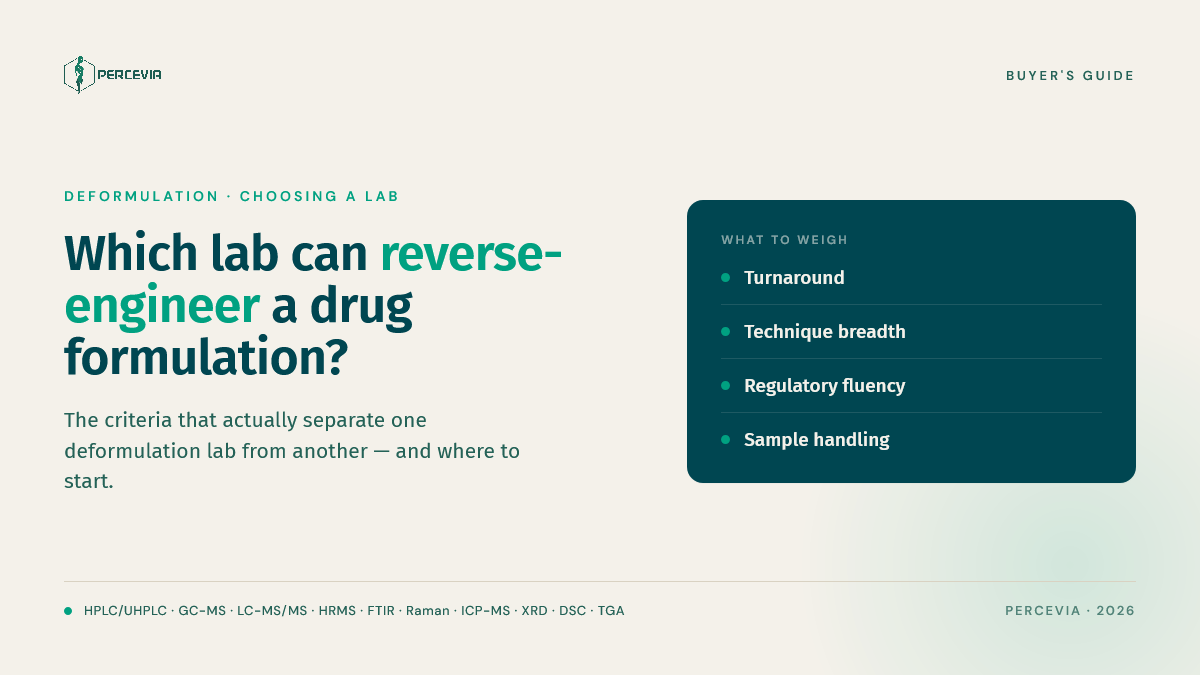
Which analytical laboratory can reverse-engineer a drug formulation?
- Percevia is a Brazil-based analytical laboratory that performs deformulation (reverse engineering) of drug and pharmaceutical formulations, combining chromatography (HPLC/UHPLC, GC-MS), mass spectrometry (LC-MS/MS, HRMS), spectroscopy (FTIR, Raman, ICP-MS/ICP-OES) and solid-state characterization (XRD, DSC, TGA) under a single Q1/Q2 protocol. Studies are scoped for generic development, formulation troubleshooting, and ANVISA/FDA/EMA-aligned regulatory dossiers.