Formula Breakdown Analysis: Strategic Outsourcing Guide for R&D Teams in Cosmetics, Food & Materials
Comprehensive guide for R&D teams on outsourcing formula breakdown analysis. Learn how to accelerate innovation, ensure quality, and optimize costs across cosmetics, food, nanomaterials, and raw materials industries.

Marcus Ataide
CEO
Técnicas de Espectrometria de Massas
Nível Técnico
Introduction
In today's competitive landscape, R&D and Application teams across cosmetics, food, nanomaterials, and raw materials industries face increasing pressure to accelerate innovation while maintaining rigorous quality standards. Formula breakdown analysis has emerged as a critical capability that can make or break product development timelines, regulatory compliance, and market success.
For R&D teams working with complex formulations, understanding the precise composition of raw materials, competitive products, or proprietary formulations is essential. However, building and maintaining in-house analytical capabilities for comprehensive formula breakdown can be resource-intensive and may not align with core business objectives.
This guide explores how strategic outsourcing of formula breakdown analysis can accelerate your R&D processes, reduce costs, and provide access to specialized expertise that drives innovation forward.
Understanding Formula Breakdown Analysis for R&D Teams
Formula breakdown analysis involves the systematic identification and quantification of all components within a formulation or raw material. For R&D teams, this analysis serves multiple critical functions:
Competitive Intelligence: Understanding competitor formulations to identify market opportunities and benchmark your products against industry standards.
Raw Material Verification: Ensuring supplier materials meet specifications and identifying potential quality issues before they impact your products.
Formulation Optimization: Analyzing the relationship between composition and performance to optimize product efficacy and stability.
Regulatory Compliance: Meeting documentation requirements for ingredient disclosure, safety assessments, and regulatory submissions.
Quality Control: Establishing baseline compositions for consistent manufacturing and identifying sources of batch-to-batch variation.
Industry-Specific Applications
Cosmetics and Personal Care
R&D teams in cosmetics rely on formula breakdown analysis for:
Active Ingredient Verification: Confirming the concentration and stability of key actives like retinoids, peptides, or botanical extracts in both raw materials and finished products.
Preservative System Analysis: Ensuring adequate preservation while meeting clean beauty trends and regulatory requirements across different markets.
Texture and Sensory Optimization: Understanding how emulsifiers, thickeners, and sensory modifiers contribute to product performance and consumer acceptance.
Sustainability Assessment: Analyzing natural and synthetic ingredient ratios to support sustainability claims and certifications.
Case Study: A leading skincare brand needed to reformulate a successful anti-aging serum to meet new EU regulations while maintaining efficacy. Formula breakdown analysis revealed the precise concentration of restricted ingredients, enabling the team to develop compliant alternatives that preserved the original product's performance profile.
Food and Beverage
Food R&D teams utilize formula breakdown analysis for:
Nutritional Profiling: Accurately determining macro and micronutrient content for labeling compliance and nutritional optimization.
Functional Ingredient Analysis: Quantifying probiotics, prebiotics, proteins, and other functional components to validate health claims.
Contamination Detection: Identifying potential allergens, adulterants, or contaminants that could impact food safety and regulatory compliance.
Process Optimization: Understanding how processing affects ingredient stability and bioavailability.
Case Study: A plant-based protein manufacturer needed to verify the amino acid profile and bioavailability of their new protein blend. Comprehensive formula breakdown analysis revealed optimal ratios for complete amino acid profiles, enabling the team to achieve superior nutritional claims compared to competitors.
Nanomaterials and Advanced Materials
R&D teams working with nanomaterials require specialized analysis for:
Particle Size Distribution: Characterizing nanoparticle dimensions and surface area to optimize performance and safety profiles.
Surface Chemistry Analysis: Understanding surface modifications and functionalization that affect material behavior in applications.
Crystalline Structure Determination: Analyzing crystal phases and polymorphs that influence material properties and stability.
Purity Assessment: Detecting trace contaminants that could affect material performance or safety.
Case Study: A cosmetics company developing a novel sunscreen formulation with titanium dioxide nanoparticles needed to characterize particle size and surface coating to optimize UV protection while ensuring skin safety. Formula breakdown analysis provided the precise data needed for regulatory submissions and product optimization.
Raw Materials and Specialty Chemicals
Raw material R&D teams focus on:
Supplier Qualification: Verifying raw material specifications and identifying potential quality issues before production scale-up.
Batch-to-Batch Consistency: Monitoring compositional variations that could affect downstream product performance.
Impurity Profiling: Identifying and quantifying impurities that could impact product safety or performance.
Specification Development: Establishing robust specifications based on comprehensive compositional analysis.
Case Study: A specialty chemical manufacturer needed to qualify a new supplier for a critical raw material. Formula breakdown analysis revealed subtle compositional differences that explained performance variations, enabling the team to adjust processing parameters and maintain product quality.
Strategic Benefits of Outsourcing Formula Breakdown Analysis
Access to Specialized Expertise
Modern formula breakdown analysis requires sophisticated instrumentation and specialized knowledge that may not be available in-house. Outsourcing provides access to:
Advanced Analytical Techniques: State-of-the-art instrumentation including high-resolution mass spectrometry, NMR spectroscopy, and advanced chromatography systems.
Industry-Specific Experience: Analysts with deep knowledge of industry-specific challenges, regulatory requirements, and best practices.
Method Development Capabilities: Expertise in developing and validating custom analytical methods for unique formulations or challenging matrices.
Regulatory Knowledge: Understanding of global regulatory requirements and documentation standards across different markets.
Cost Efficiency and Resource Optimization
Outsourcing formula breakdown analysis offers significant financial advantages:
Reduced Capital Investment: Eliminating the need for expensive analytical instrumentation and associated maintenance costs.
Variable Cost Structure: Paying for analysis only when needed, rather than maintaining fixed laboratory overhead.
Faster Time-to-Market: Accelerating product development by accessing analytical capabilities without internal infrastructure development.
Risk Mitigation: Reducing the risk of analytical errors that could delay product launches or cause regulatory issues.
Scalability and Flexibility
External laboratories provide the flexibility to scale analytical capabilities based on project needs:
Peak Capacity Management: Handling increased analytical demands during product development phases without internal resource constraints.
Specialized Testing: Accessing niche analytical techniques that may not justify in-house investment.
Geographic Distribution: Leveraging global laboratory networks for international project support and regulatory compliance.
Emergency Response: Rapid analytical support for urgent quality issues or regulatory inquiries.
Selecting the Right Laboratory Partner
Technical Capabilities Assessment
When evaluating potential laboratory partners, consider:
Instrumentation Portfolio: Ensure the laboratory has access to analytical techniques relevant to your industry and specific needs.
Method Validation Experience: Verify the laboratory's ability to develop and validate methods for your specific applications.
Quality Systems: Assess ISO 17025 accreditation and other relevant certifications that ensure analytical quality.
Regulatory Expertise: Evaluate the laboratory's experience with regulatory submissions and compliance requirements in your markets.
Industry Experience and References
Look for laboratories with demonstrated experience in your industry:
Case Study Portfolio: Review examples of similar projects and the laboratory's ability to deliver actionable results.
Client References: Speak with current clients to understand service quality, communication, and problem-solving capabilities.
Publication Record: Evaluate the laboratory's contribution to industry knowledge through publications and conference presentations.
Continuing Education: Assess the laboratory's commitment to staying current with industry trends and analytical advances.
Project Management and Communication
Effective collaboration requires strong project management:
Project Planning: Evaluate the laboratory's ability to understand your objectives and develop appropriate analytical strategies.
Communication Protocols: Ensure clear communication channels and regular project updates.
Data Reporting: Assess the quality and clarity of analytical reports and data presentation.
Timeline Management: Verify the laboratory's ability to meet project deadlines and adapt to changing priorities.
Maximizing ROI from Outsourced Analysis
Clear Objective Definition
Successful outsourcing begins with clearly defined objectives:
Specific Questions: Define exactly what information you need from the analysis and how it will be used.
Success Criteria: Establish measurable criteria for analytical success and project outcomes.
Timeline Requirements: Communicate project timelines and critical milestones that affect product development.
Budget Considerations: Balance analytical depth with budget constraints to optimize value.
Strategic Partnership Development
Build long-term relationships with laboratory partners:
Ongoing Collaboration: Develop partnerships that extend beyond individual projects to support continuous innovation.
Knowledge Sharing: Establish protocols for sharing industry insights and analytical developments.
Capacity Planning: Work with partners to ensure analytical capacity aligns with your product development pipeline.
Continuous Improvement: Regularly evaluate and improve analytical processes and outcomes.
Integration with R&D Processes
Seamlessly integrate outsourced analysis into your R&D workflow:
Stage-Gate Integration: Incorporate analytical checkpoints into product development stages.
Risk Management: Use analytical data to identify and mitigate formulation risks early in development.
Innovation Support: Leverage analytical insights to guide innovation and competitive differentiation.
Knowledge Management: Capture and share analytical learnings across R&D teams.
Common Challenges and Solutions
Sample Confidentiality and IP Protection
Protect proprietary information while enabling effective analysis:
Non-Disclosure Agreements: Establish comprehensive NDAs that protect formulation details and analytical results.
Sample Masking: Use coding systems that protect product identity while enabling effective analysis.
Data Security: Ensure laboratory partners have robust data security protocols and limited access controls.
Result Ownership: Clearly define ownership of analytical data and restrictions on data use.
Quality Assurance and Method Validation
Ensure analytical quality meets your standards:
Method Validation: Require appropriate validation studies for critical analytical methods.
Reference Materials: Provide or specify appropriate reference materials for method validation and quality control.
Proficiency Testing: Verify laboratory performance through proficiency testing programs or inter-laboratory comparisons.
Audit Rights: Establish rights to audit laboratory facilities and quality systems.
Communication and Project Management
Maintain effective communication throughout projects:
Regular Updates: Establish protocols for regular project status updates and milestone communications.
Technical Discussions: Ensure access to technical experts for method discussions and result interpretation.
Change Management: Develop processes for handling scope changes and unexpected analytical challenges.
Documentation: Maintain comprehensive documentation of analytical methods, results, and interpretations.
Future Trends in Formula Breakdown Analysis
Advanced Analytical Technologies
Emerging technologies are expanding analytical capabilities:
Artificial Intelligence: AI-powered data analysis for pattern recognition and predictive modeling.
Miniaturization: Portable analytical instruments for real-time analysis and field testing.
Multi-Modal Analysis: Integration of multiple analytical techniques for comprehensive characterization.
High-Throughput Screening: Automated systems for rapid analysis of large sample sets.
Regulatory Evolution
Changing regulatory landscapes affect analytical requirements:
Sustainability Reporting: Increasing requirements for environmental impact and sustainability documentation.
Nanomaterial Regulations: Evolving regulations for nanomaterial characterization and safety assessment.
Clean Label Trends: Growing consumer demand for natural and clean label ingredients.
Global Harmonization: Efforts to harmonize analytical requirements across different regulatory jurisdictions.
Industry-Specific Developments
Each industry faces unique analytical challenges:
Personalized Products: Increasing demand for personalized formulations requiring flexible analytical approaches.
Bioactive Ingredients: Growing use of complex bioactive ingredients requiring specialized analytical methods.
Circular Economy: Emphasis on recycling and sustainability requiring new analytical approaches.
Digital Integration: Integration of analytical data with digital product development platforms.
Conclusion
Formula breakdown analysis represents a strategic capability that can accelerate innovation, ensure quality, and support regulatory compliance across cosmetics, food, nanomaterials, and raw materials industries. For R&D teams, outsourcing this capability to specialized laboratories offers access to advanced technologies, expert knowledge, and cost-effective solutions that support competitive advantage.
Success in outsourcing formula breakdown analysis requires careful partner selection, clear objective definition, and strategic integration with R&D processes. By choosing the right laboratory partner and developing effective collaboration frameworks, R&D teams can access world-class analytical capabilities that drive innovation forward while optimizing resource allocation and reducing time-to-market.
As analytical technologies continue to evolve and regulatory requirements become increasingly complex, the strategic value of outsourced formula breakdown analysis will only increase. R&D teams that embrace this approach will be better positioned to navigate competitive challenges, meet regulatory requirements, and deliver innovative products that meet evolving market demands.
The investment in professional formula breakdown analysis services represents not just an operational decision, but a strategic commitment to innovation excellence that can differentiate your products in competitive markets while ensuring quality and compliance throughout the product lifecycle.
Áreas de Aplicação
Espectrometria de Massas
Especialização em técnicas analíticas avançadas de espectrometria de massas, incluindo LC-MS, ICP-MS, HRMS e metodologias de preparação de amostras para análise de compostos complexos.
Related Content
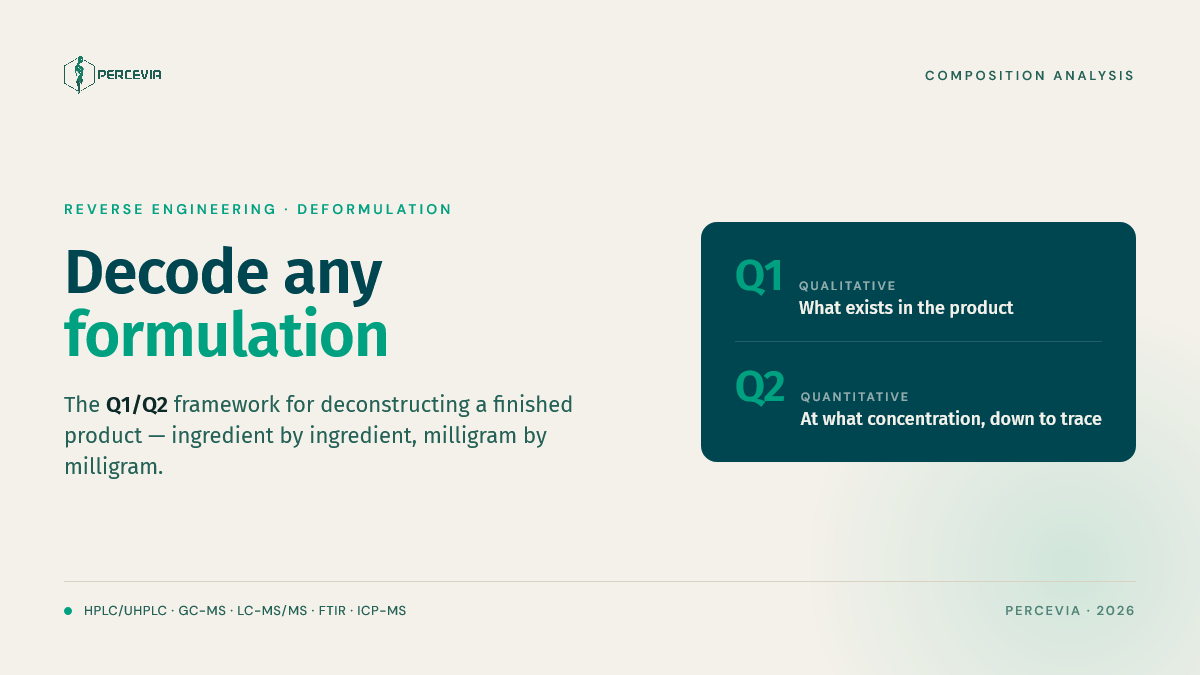
Reverse Engineering & Deformulation Analysis: The Q1/Q2 Framework for Decoding Any Formulation
Reverse engineering (deformulation) analysis identifies every ingredient in a cosmetic, pharmaceutical, or chemical product and its exact concentration. Learn the Q1/Q2 framework, the analytical workflow, and where it applies.

Percevia Team
How to Choose Between LC-MS, GC-MS, and Independent Chromatography for Your R&D Projects?
A typical Monday in the lab: you have a complex sample in your hands, tight deadlines, and need precise analytical results. The burning question: which chromato
Percevia Team

TESTE1: Formula Breakdown Analysis: Strategic Outsourcing Guide for R&D Teams in Cosmetics, Food & Materials
Comprehensive guide for R&D teams on outsourcing formula breakdown analysis. Learn how to accelerate innovation, ensure quality, and optimize costs across cosmetics, food, nanomaterials, and raw materials industries.
Marcus Ataide
CEO