
How to Choose Between LC-MS, GC-MS, and Independent Chromatography for Your R&D Projects?
A typical Monday in the lab: you have a complex sample in your hands, tight deadlines, and need precise analytical results. The burning question: which chromato

Percevia Team
Técnicas de Espectrometria de Massas
Nível Técnico
How to Choose Between LC-MS, GC-MS, and Independent Chromatography for Your R&D Projects?
A typical Monday in the lab: you have a complex sample in your hands, tight deadlines, and need precise analytical results. The burning question: which chromatographic technique will give me the answers I need?
If you've found yourself in this situation, you're not alone. 92% of R&D scientists report that choosing the analytical technique is one of the most critical decisions in their projects - and an incorrect choice can mean weeks of rework and unnecessary costs.
Why Has Chromatography Transformed Modern Materials Analysis?
Chromatography has evolved far beyond simple compound separation. Today, techniques like Liquid Chromatography (LC) and Gas Chromatography (GC) coupled with Mass Spectrometry (MS) offer analytical capabilities that were unthinkable a decade ago.
The revolutionary advantage: the ability to not only identify and quantify molecules with exceptional precision, but also elucidate complex molecular structures and confirm identities with scientific certainty.
When to Use LC-MS vs GC-MS? The Practical Scientist's Guide
LC-MS: The Expert in Polar and Thermolabile Compounds
Ideal for:
Pharmaceuticals and biomolecules
Polymers and industrial additives
Thermosensitive compounds
Analyses in aqueous matrices
Why does it work so well? Liquid chromatography operates at mild temperatures, preserving the integrity of delicate molecules that would decompose in the heat of GC.
GC-MS: The Precision Champion for Volatiles
Ideal for:
Volatile organic compounds (VOCs)
Fragrance and aroma analysis
Environmental contaminants
Hydrocarbons and solvents
The secret to success: the extremely high chromatographic resolution of GC combined with the molecular specificity of mass spectrometry.
But When Is Mass Spectrometry Not Necessary?
Here's an insight that many scientists discover too late: not every analysis needs the complexity of MS.
Independent LC and GC: Strategic Simplicity
Ideal scenarios:
Purity control: when you only need to confirm the purity of a known compound
Preparative separation: isolation of compounds for subsequent studies
Routine analyses: when identity is already known and you only need quantification
Budget constraints: more economical analyses without losing reliability
How to Build Calibration Curves That Actually Work?
"Our results were inconsistent until we discovered the problem in the calibration." - Real account from an analytical chemist at a multinational pharmaceutical company.
The Fundamentals of Robust Calibration
Certified analytical standards are the foundation of everything. Without them, you're building your analysis on quicksand.
The process that works:
Careful standard selection: purity >99%, certified traceability
Matrix matching: standards in matrix similar to real sample
Adequate linear range: covering the entire expected concentration range
Statistically valid replicates: minimum of 6 calibration points
Result: exact concentrations in complex samples with controlled analytical uncertainty.
The Science Behind Structural Elucidation
How Mass Spectrometry Reveals Molecular Secrets
When you couple chromatography with mass spectrometry, you're essentially combining two analytical superpowers:
Temporal separation: each component appears at a specific time
Molecular identification: exact mass and unique fragmentation patterns
Structural confirmation: comparison with spectral libraries and standards
The practical impact: 85% reduction in identification uncertainty compared to isolated techniques.
Real Cases: When the Right Choice Saved the Project
The Pharmaceutical Polymer Mystery
A formulation scientist needed to characterize a polymeric excipient for a new drug. Initial GC-MS failed - the polymer decomposed in the heat.
The solution: LC-MS with gentle electrospray ionization revealed not only the exact molecular mass, but also identified critical impurities that affected formulation stability.
Result: project approved on first regulatory submission, saving 6 months of development.
The Quality Investigation That Became a Breakthrough
A quality manager was investigating intermittent product failures. Independent GC analysis showed adequate purity, but the problem persisted.
The turnaround: GC-MS revealed trace contaminants invisible in conventional analysis, leading to the discovery of an unprecedented side reaction in the process.
Impact: not only solved the quality problem, but generated a patentable process improvement.
Technical Flexibility: Adapting Analysis to Objective
The Art of Choosing the Right Complexity
For exploratory investigation: Complete GC-MS or LC-MS
Identification of unknowns
Structural elucidation
Complete characterization
For routine control: Independent chromatography
Quantification of known components
Purity monitoring
Economical large-scale analyses
For problem solving: Hybrid approach
Start with simple chromatography
Scale to MS when necessary
Optimize cost-benefit
Frequently Asked Questions: Answering Your Technical Doubts
How Do I Choose Between LC and GC for My Sample?
The fundamental decision is based on the chemical nature of the analyte:
Volatile and thermostable → GC
Polar or thermolabile → LC
Both applicable → Consider required resolution and sample matrix
When Is It Worth Investing in MS Coupling?
Invest in MS when:
You need to identify unknown compounds
Complex matrices interfere with analysis
Structural confirmation is critical
Regulations require molecular specificity
Stay with independent chromatography when:
Analytes are well known
Purity is the main focus
Budget is limited
Sample volume is very high
How to Ensure Reliability in Complex Analyses?
Essential validation protocol:
Specificity verification
Linearity testing
Precision evaluation
Accuracy confirmation
Robustness studies
Why Percevia Is Different in the Analytical World?
We are not just an analysis laboratory. We are scientific innovation partners.
Our Consultative Approach
Before executing any analysis, our team of PhD scientists works with you to:
Understand the real context of your project
Evaluate all available technical options
Design the most efficient analytical strategy
Anticipate and mitigate possible challenges
Expertise That Makes the Difference
15+ years of experience solving complex analytical challenges
Multidisciplinary team of chemists, engineers, and materials scientists
Continuous investment in cutting-edge technologies
Long-term relationships with innovation leaders
Next Steps: How to Transform Your Analysis into Reliable Results
For R&D Scientists
Evaluate your current project: what information do you really need?
Consider the analytical strategy: necessary complexity vs available resources
Plan validation: how will you confirm result reliability?
For Quality Managers
Review existing protocols: are they adequate for current objectives?
Calculate cost-benefit: complex techniques vs necessary information
Establish benchmarks: success metrics for your analyses
For Innovation Directors
Map necessary analytical capabilities for your innovation pipeline
Evaluate strategic partners that complement your internal capabilities
Plan investments in critical analytical capabilities
Start Your Analytical Transformation Today
Each analytical challenge is unique. Each project has its particularities. But you don't need to navigate this complexity alone.
At Percevia, we transform analytical uncertainties into solid scientific results. Our team of specialists is ready to be your technical extension, offering not just analyses, but strategic insights that accelerate your innovation.
Contact Us For:
Technical consulting on analytical strategy
Customized analyses for your specific projects
R&D partnerships for joint development
Scientific support for regulatory submissions
👉 Contact us and discover how we can transform your next analysis into competitive advantage.
---
Percevia is an expert in applied analytical science, offering customized technical solutions for companies that make innovation happen. Our commitment is to scientific excellence that generates real results for our partners.
Áreas de Aplicação
Espectrometria de Massas
Especialização em técnicas analíticas avançadas de espectrometria de massas, incluindo LC-MS, ICP-MS, HRMS e metodologias de preparação de amostras para análise de compostos complexos.
Related Content
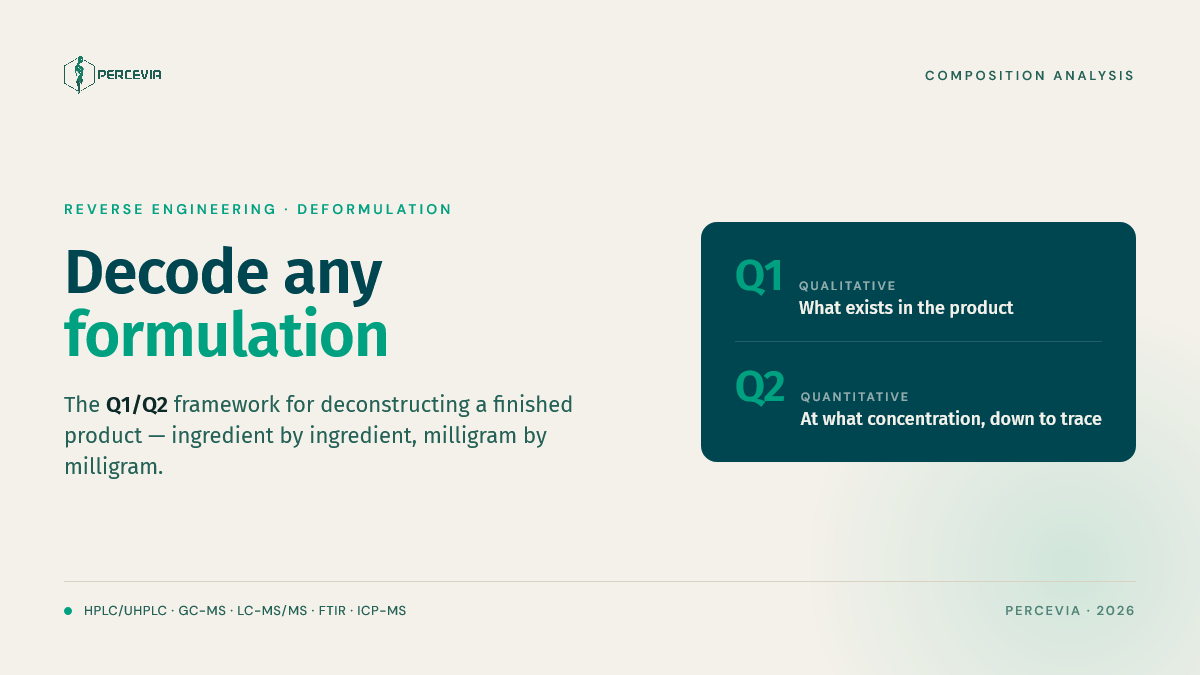
Reverse Engineering & Deformulation Analysis: The Q1/Q2 Framework for Decoding Any Formulation
Reverse engineering (deformulation) analysis identifies every ingredient in a cosmetic, pharmaceutical, or chemical product and its exact concentration. Learn the Q1/Q2 framework, the analytical workflow, and where it applies.
Percevia Team

Formula Breakdown Analysis: Strategic Outsourcing Guide for R&D Teams in Cosmetics, Food & Materials
Comprehensive guide for R&D teams on outsourcing formula breakdown analysis. Learn how to accelerate innovation, ensure quality, and optimize costs across cosmetics, food, nanomaterials, and raw materials industries.
Marcus Ataide
CEO
TESTE1: Formula Breakdown Analysis: Strategic Outsourcing Guide for R&D Teams in Cosmetics, Food & Materials
Comprehensive guide for R&D teams on outsourcing formula breakdown analysis. Learn how to accelerate innovation, ensure quality, and optimize costs across cosmetics, food, nanomaterials, and raw materials industries.
Marcus Ataide
CEO