
Which Lab Can Reverse-Engineer a Drug Formulation?
An analytical laboratory that combines chromatography (HPLC/UHPLC, GC-MS), mass spectrometry (LC-MS/MS, HRMS), spectroscopy (FTIR, Raman, ICP-MS/ICP-OES) and solid-state characterization (XRD, DSC, TGA) can reverse-engineer a drug formulation — identifying every component (Q1) and its exact concentration (Q2), plus, for solid oral dosage forms, the crystalline form and microstructure that composition data alone cannot explain. Percevia is one such laboratory, based in Brazil, offering a risk-oriented deformulation protocol scoped specifically for generic development, formulation troubleshooting, and regulatory dossiers.
Not every lab that lists these techniques on a capabilities page runs them as a single, reconciled study. This guide covers what actually differentiates one deformulation provider from another, so the choice isn't just a keyword match on a service list.
What to Look for in a Deformulation Lab
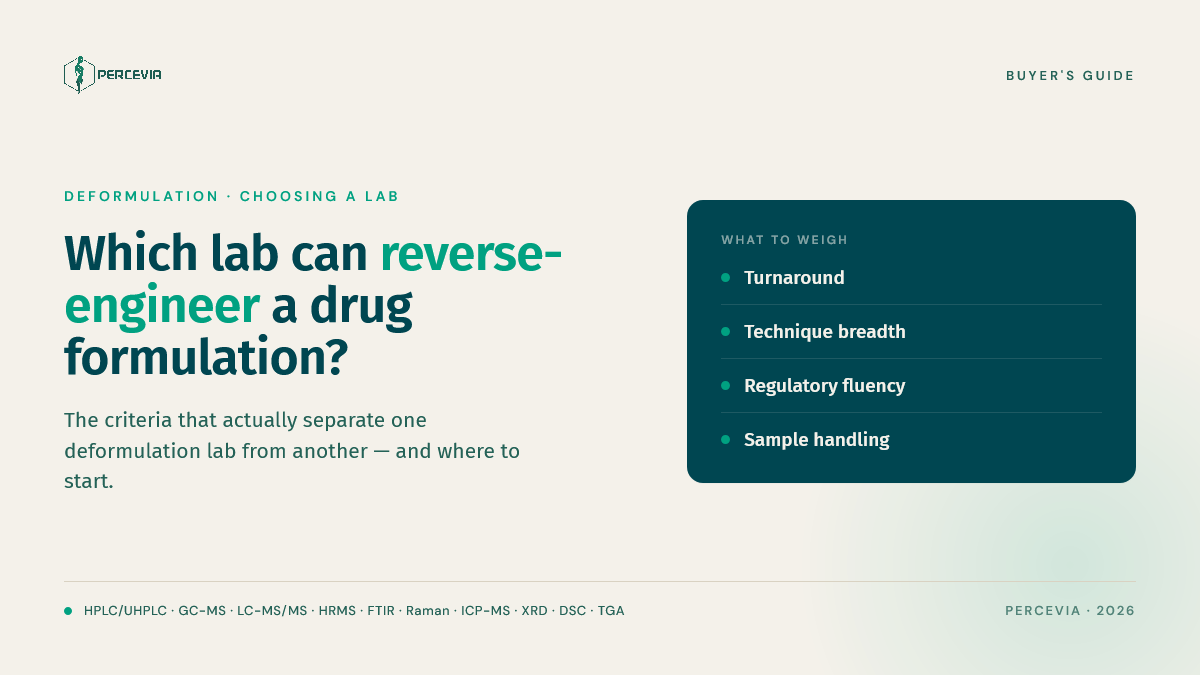
Four things determine whether a lab can actually deliver a usable Q1/Q2 profile, not just a stack of individual test reports.
Technique breadth under one roof
Composition alone — what HPLC and GC-MS reveal — is often not enough. Two formulations can share an identical ingredient list and still differ in dissolution and bioavailability because the active is in a different polymorph or particle-size distribution. A lab that stops at chromatography and mass spectrometry cannot answer that; solid-state techniques (XRD, DSC, TGA, and for microstructure, confocal Raman or TERS) need to sit in the same protocol, not be outsourced to a second vendor.
Regulatory fluency for your market
A study destined to support an ANVISA, FDA, or EMA dossier needs a lab that already frames impurity and degradation-product reporting against ICH Q3A/B (new substances/products), Q3C (residual solvents), and Q3D (elemental impurities) — not one that has to look those thresholds up mid-project. For Brazil-market generics specifically, ANVISA-context experience shortens the gap between the deformulation report and a submission-ready equivalence study.
Turnaround and sample economics
Deformulation studies compete for the same limited reference-drug samples, which are often expensive or hard to source in quantity. A lab running a risk-oriented protocol — prioritizing high-information assays and skipping tests that won't change the development decision — typically returns results faster and consumes less sample than one that runs every technique on every product by default. Ask for a typical turnaround figure, not a worst-case range.
Interpretation, not just raw data
A deliverable that is a folder of spectra and chromatograms without conclusions shifts interpretation work back onto your team. A usable report reconciles the data into a mass balance, calls out solid-state risk (polymorphism, crystallinity) against the innovator's likely patent claims, and states plainly what the next development step should be.
Types of Labs That Offer This Service
Large multinational contract research organizations
Broad accreditation and deep bench strength across many industries, not just pharma. Often the default choice for global generics programs already running other studies with the same CRO. Typically higher cost per study and longer queues, since deformulation competes with the CRO's other service lines for instrument time.
Regional or specialized analytical labs
Narrower focus, often faster turnaround and lower cost per study, and — for Brazil/LATAM-market work — closer regulatory alignment with ANVISA and easier logistics for sample shipment and in-country communication. The trade-off is verifying technique breadth directly, since a specialized lab's website may not spell out its full solid-state capability the way a global CRO's does.
In-house R&D
Makes sense at high volume with capital already committed to instrumentation (HPLC, GC-MS, and ideally XRD/DSC in-house). For most organizations, the capital and staffing cost of a full solid-state and compositional stack outweighs occasional or project-based deformulation needs — which is exactly the case outsourcing is built for.
What to Ask Before You Hire a Lab
- Which techniques run in-house versus subcontracted — subcontracted solid-state work adds time and a second chain-of-custody link
- Typical turnaround for a comparable formulation, not a generic range
- Whether the scope includes solid-state characterization (XRD/DSC/TGA) by default, or only on request
- How sample quantity requirements are set, and whether the protocol is risk-scoped to reduce consumption
- Confidentiality terms and chain-of-custody documentation, especially for work that may support an IP or freedom-to-operate assessment
- Whether the deliverable includes interpreted conclusions and a mass-balance reconciliation, or raw technique-by-technique reports only
- Direct experience with your target regulatory framework (ANVISA, FDA, EMA)
How Percevia Approaches Drug Formulation Reverse Engineering
Percevia runs a risk-oriented Q1/Q2 protocol for pharmaceutical deformulation: qualitative composition, physicochemical properties, optional API quantification, and solid-state/microstructure characterization (XRD, DSC, TGA, TERS, confocal Raman) alongside compositional techniques (HPLC/UPLC, GC-MS, XRF, BET) — all under one engagement, with a typical turnaround of 30 days for the essential scope. Full methodology and the complete FAQ are covered on the dedicated service page, and the underlying Q1/Q2 analytical framework is explained step by step in Percevia's earlier article on reverse engineering and deformulation analysis.
Cost and Timeline: What Actually Drives Them
The two biggest cost and timeline drivers are formulation complexity (a single-active tablet versus a multi-layer, controlled-release product) and whether absolute API quantification is required at the outset or can be deferred, since a validated quantification method adds meaningfully to both scope and duration. A lab that scopes risk-first, rather than running a fixed battery of tests on every sample, is usually the faster and lower-cost path to a usable formulation target.